
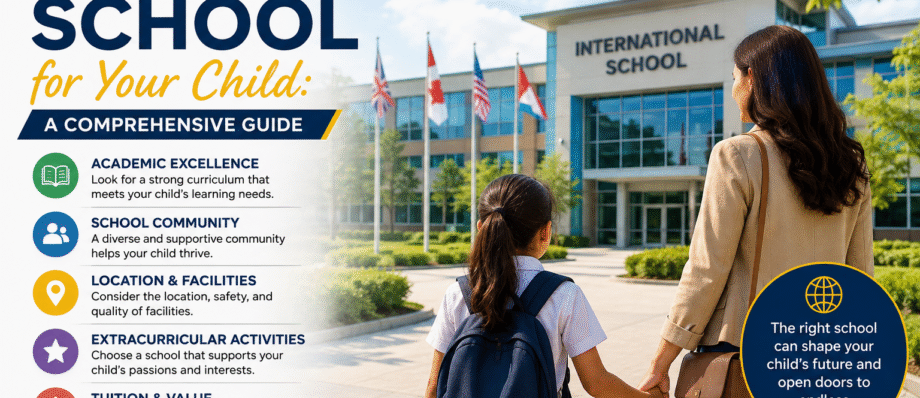
Choosing the Right International School for Your Child: A Comprehensive Guide
Understanding International School Curricula
Choosing the right school is one of the most important decisions parents make. In Malaysia, families have access to a wide range of international schools offering different curricula, teaching approaches, subjects, assessment methods, and pathways to university.
For parents who are unfamiliar with the international-school system, terms such as British curriculum, Cambridge, IGCSE, International Baccalaureate (IB), American curriculum, Australian curriculum, and IPC can be confusing. Two schools may both describe themselves as “international schools” while offering very different educational experiences.
This guide explains the major international-school curricula commonly found in Malaysia, how they differ, what parents should consider, and how to choose a programme that fits a child’s needs and future plans.
What Is an International School Curriculum?
An international school curriculum is an educational framework designed to provide students with an education that is internationally oriented and, in many cases, prepares them for further education in different countries.
International schools in Malaysia may follow:
- British-based curricula
- Cambridge programmes
- International Baccalaureate programmes
- American curricula
- Australian curricula
- Other international or school-developed programmes
The term “international school” does not automatically mean that every school follows the same curriculum.
A school might use one curriculum throughout the school or combine different frameworks at different stages.
For example, a school could have an early-years programme, a primary curriculum, and then Cambridge IGCSE at secondary level.
Therefore, parents should always ask the school exactly which curriculum their child will follow at each stage.
Why Does the Curriculum Matter?
The curriculum affects much more than the subjects a child studies.
It can influence:
- Teaching methods
- Assessment
- Homework
- Examinations
- Subject choices
- Learning pace
- University preparation
- Transferability between schools
- Opportunities for extracurricular learning
- The development of independent learning skills
For example, one curriculum may place a strong emphasis on external examinations, while another may place greater emphasis on projects, inquiry and continuous assessment.
Neither approach is automatically better for every child.
The important question is:
Which curriculum and school environment are the best match for this particular child?
1. British Curriculum
The British curriculum is one of the most common international-school pathways in Malaysia.
Many schools use a progression based on:
Early Years → Primary → Secondary → IGCSE → A Levels or another post-16 qualification
The exact structure varies from school to school.
The British approach generally provides a structured progression through different stages of education.
At the secondary level, students may eventually take Cambridge IGCSE or another internationally recognised qualification.
After IGCSE, students may continue to qualifications such as:
- A Levels
- International Baccalaureate
- Foundation programmes
- Other pre-university qualifications
Why parents choose it
The British pathway can be attractive to families who:
- Are considering universities in the UK
- Want a structured academic pathway
- Prefer subject-based qualifications
- Want internationally recognised examinations
- May relocate between countries using similar international programmes
2. Cambridge Curriculum and IGCSE
Cambridge programmes are particularly important in Malaysia’s international-school sector.
Cambridge IGCSE is a widely recognised secondary qualification.
Students can study a variety of subjects, depending on what their school offers.
Typical subjects can include:
- Mathematics
- English
- Biology
- Chemistry
- Physics
- Geography
- History
- Business
- Economics
- Computer Science
- Languages
The exact subject list varies between schools.
Cambridge IGCSE is generally taken by students in the secondary-school years, although the exact age and programme structure can differ.
What makes IGCSE different?
IGCSE is primarily a qualification rather than simply a teaching philosophy.
Parents should therefore distinguish between:
British curriculum
and
Cambridge IGCSE qualification
They are related, but they are not exactly the same thing.
A school can use a British-style curriculum and prepare students for Cambridge IGCSE examinations.
3. International Baccalaureate (IB)
The International Baccalaureate is another major international educational framework.
IB offers several programmes:
Primary Years Programme (PYP)
Generally designed for younger students.
The PYP emphasises inquiry, conceptual understanding and connections between different areas of learning.
Middle Years Programme (MYP)
Designed for students in the middle-school years.
It encourages students to connect subjects and develop broader conceptual understanding.
Diploma Programme (DP)
The IB Diploma Programme is a two-year programme for students in the later secondary years.
Students study a range of subjects and complete additional components that are distinctive to the IB Diploma.
These include:
- Theory of Knowledge
- Extended Essay
- Creativity, Activity, Service (CAS)
Why do families choose IB?
The IB approach can appeal to families who value:
- Inquiry-based learning
- Independent research
- International-mindedness
- Interdisciplinary learning
- Critical thinking
- Broader academic development
The IB pathway can also be useful for families considering universities in different countries.
4. American Curriculum
Some international schools in Malaysia follow an American-style curriculum.
The structure can be different from the British system.
Instead of focusing primarily on a sequence such as IGCSE and A Levels, American schools may organise education around:
- Elementary School
- Middle School
- High School
Students may earn credits toward a high-school diploma.
Some schools also offer programmes such as:
- Advanced Placement (AP)
- SAT preparation
- Other university-preparation pathways
Why choose an American curriculum?
It can be particularly attractive to families considering universities in the United States or families who are already familiar with the American education system.
It may also offer greater flexibility in subject selection in the later school years, depending on the school.
5. Australian Curriculum
Some international schools use the Australian Curriculum or Australian state-based programmes.
Australian education generally provides structured learning across areas such as:
- English
- Mathematics
- Science
- Humanities
- Languages
- Health and Physical Education
- Arts
- Technologies
At senior secondary level, qualifications can vary depending on the school and Australian state or territory system being used.
Why might parents choose it?
An Australian curriculum may appeal to families considering:
- Australian universities
- Australia as a future study destination
- A curriculum familiar to Australian families
- A balanced academic and extracurricular programme
6. Singapore Curriculum
Some schools in the region also offer Singapore-based educational programmes or approaches.
Singapore’s education system is widely recognised for its strong academic emphasis, particularly in:
- Mathematics
- Science
- English
- Structured problem-solving
Parents considering a Singapore-oriented curriculum should examine the exact programme offered by the school rather than assuming that every school uses the same Singapore curriculum.
Comparing Major International Curricula
| Curriculum | Common Strength | Assessment Style | Potentially Suitable For |
|---|---|---|---|
| British | Structured academic progression | Exams + coursework depending on stage | Families considering UK/international universities |
| Cambridge IGCSE | International secondary qualification | Strong examination component | Students wanting internationally recognised qualifications |
| IB | Inquiry and broader learning | Internal + external assessment | Students who enjoy research and interdisciplinary learning |
| American | Flexibility and credit-based progression | Coursework + assessments | Families considering US universities |
| Australian | Broad curriculum | School/state-based assessment | Families considering Australia |
| Singapore | Strong academic foundations | Structured assessments | Students comfortable with rigorous academic study |
This table is only a general comparison. Individual schools can implement the same curriculum very differently.
Curriculum vs Teaching Style
One of the biggest mistakes parents can make is choosing a school based solely on the curriculum name.
For example, two schools may both offer Cambridge programmes but have completely different classroom environments.
One may emphasise:
- Traditional teaching
- Textbooks
- Frequent tests
- Structured homework
Another might emphasise:
- Projects
- Technology
- Group work
- Presentations
- Independent research
Therefore, parents should ask:
“How do you actually teach this curriculum?”
rather than simply:
“Which curriculum do you offer?”
Which Curriculum Is Best for My Child?
There is no universal answer.
The best curriculum depends on your child’s:
- Learning style
- Academic strengths
- Interests
- Personality
- Language ability
- Long-term goals
- Possible university destination
- Future relocation plans
A child who enjoys independent research
An inquiry-focused programme such as IB may be appealing.
A child who prefers clear academic structure
A British/Cambridge pathway may be a good fit.
A family planning to move to the United States
An American curriculum may provide a more familiar pathway.
A family planning university in Australia
An Australian pathway may be worth considering.
However, these are only starting points. Parents should compare the actual schools rather than choosing based solely on the curriculum label.
What About University Recognition?
This is one of the most common questions parents ask.
International qualifications such as Cambridge IGCSE, A Levels and IB are widely used internationally, but university admission requirements vary by institution and country.
Before selecting a school, parents should research:
- Which qualifications the school offers
- Which universities its graduates attend
- Entry requirements for the countries you are considering
- Required subjects for specific university degrees
- English-language requirements
- Additional entrance examinations where applicable
For example, a student planning to study medicine may need particular science subjects.
A student interested in engineering may need strong mathematics and physics preparation.
Therefore, future university goals can influence subject choices much earlier than parents expect.
How Much Does School Location Matter?
It matters more than many parents realise.
A school may have an excellent academic reputation, but a very long daily commute can affect a child’s:
- Sleep
- Homework time
- Extracurricular activities
- Family time
- Energy levels
For families living in Kuala Lumpur, schools in areas such as:
- Mont Kiara
- Sri Hartamas
- Bangsar
- Ampang
- Cheras
- Bukit Jalil
- Petaling Jaya
- Subang Jaya
may be considered depending on where the family lives.
When comparing schools, calculate the actual journey during school hours, not just the distance on a map.
What Should Parents Ask During a School Visit?
A school visit is one of the best ways to understand whether a programme is suitable.
Here are some useful questions.
Curriculum
- Which curriculum do you follow?
- Is the curriculum the same from primary through secondary?
- Which examination board do you use?
- What qualifications do students receive?
- What happens if we move to another country?
Teaching
- How large are the classes?
- How much homework is expected?
- How do teachers support students who are struggling?
- How are advanced students challenged?
- How much project-based learning is used?
Assessment
- How often are students assessed?
- Are there external examinations?
- How are parents informed about progress?
- How does the school prepare students for major examinations?
University preparation
- Which universities do graduates typically attend?
- What university counselling is provided?
- Which subjects are available at senior secondary level?
- Are university application advisers available?
Student wellbeing
- How does the school support student wellbeing?
- What pastoral care is available?
- How does the school handle bullying?
- What support is available for students with additional learning needs?
International School Fees in Malaysia
School fees can vary significantly between international schools.
Parents should not compare only the advertised annual tuition fee.
The total cost may include:
- Application fee
- Registration fee
- Tuition fee
- Deposit
- Technology fee
- Examination fee
- Transport
- Uniform
- Books
- Meals
- Extracurricular activities
- School trips
- Optional programmes
A school with a lower advertised tuition fee may not necessarily be cheaper once all additional costs are included.
Before enrolling, request a complete fee schedule.
Does an International School Need to Be Expensive?
Not necessarily.
International schools in Malaysia have different fee structures and facilities.
Some schools focus heavily on premium facilities and extensive extracurricular programmes, while others operate with a simpler model.
Parents should consider value rather than price alone.
Ask:
What am I actually receiving for the annual cost?
Compare:
- Teacher quality
- Class size
- Curriculum
- Facilities
- University preparation
- Student support
- Extracurricular opportunities
- Location
English and Language Learning
Language is another important consideration.
Many international schools use English as a primary teaching language, but students may also study:
- Malay
- Mandarin
- French
- Spanish
- Other languages
Multilingual education can be valuable for families who want children to maintain or develop multiple languages.
Parents should ask:
- What is the main teaching language?
- How much additional-language instruction is provided?
- Are English-language support programmes available?
- What happens if a child is not yet fluent in English?
This is particularly important when a child transfers from a national-school or non-English-speaking educational background.
Extracurricular Activities
Education is not only about classroom learning.
When comparing international schools, examine the extracurricular programme.
Possible activities include:
Sports
- Football
- Basketball
- Swimming
- Tennis
- Badminton
- Athletics
Creative activities
- Art
- Music
- Drama
- Dance
- Photography
Academic activities
- Coding
- Robotics
- Debate
- Public speaking
- Science clubs
- Mathematics competitions
Leadership
- Student councils
- Community projects
- Charity activities
- Leadership programmes
A good extracurricular programme can help children discover interests that may not be obvious through academic subjects alone.
Technology and Digital Learning
Modern international schools increasingly use technology in teaching.
Parents can ask about:
- Student devices
- Learning management systems
- Online homework
- Digital libraries
- Coding
- Robotics
- AI literacy
- Cyber safety
However, technology should support learning rather than simply provide expensive equipment.
Ask the school:
“How does technology improve learning in the classroom?”
This question can reveal much more than asking whether every student has a tablet or laptop.
Supporting Different Learning Needs
Every child learns differently.
Some children may need additional support with:
- Reading
- Writing
- Mathematics
- Language
- Attention
- Organisation
Other students may require greater academic challenge.
Parents should ask about:
- Learning-support teachers
- Counsellors
- Individual support plans
- Specialist referrals
- Gifted education
- English-language support
A school’s ability to identify and support individual learning needs can be just as important as its examination results.
International Schools and School Transfers
One advantage of internationally recognised curricula is that they can sometimes make moving between countries easier.
However, transferring schools is never completely automatic.
Schools may differ in:
- Year-group structure
- Curriculum sequence
- Subject choices
- Academic expectations
- Assessment systems
If your family may relocate, ask potential schools:
“How easy is it for a student to transfer into or out of this programme?”
Keeping school reports, examination results and academic records organised can make future transitions easier.
Common Mistakes Parents Should Avoid
Mistake 1: Choosing the most famous school
A famous school isn’t necessarily the best match for every child.
Mistake 2: Choosing only by examination results
Academic results are useful, but they don’t tell you everything about school culture or student wellbeing.
Mistake 3: Ignoring commute time
A long daily commute can become exhausting.
Mistake 4: Looking only at tuition fees
Additional costs can significantly change the total expense.
Mistake 5: Choosing a curriculum based only on university country
A child should also be comfortable with the learning style.
Mistake 6: Not visiting the school
Online information cannot fully show classroom culture.
Mistake 7: Ignoring future subject choices
If your child already has a possible career interest, investigate the subjects required for that pathway.
A Simple Decision-Making Framework
When choosing an international school in Malaysia, consider five major questions.
1. Where does your child want to go?
Think about possible future university countries.
2. How does your child learn best?
Consider whether they prefer structure, projects, collaboration or independent research.
3. What can your family realistically afford?
Calculate the total annual cost, not just tuition.
4. How important is location?
Consider the daily commute.
5. What kind of school environment does your child need?
Think about:
- Class size
- Student support
- Sports
- Arts
- Technology
- Academic challenge
- Language development
Final Thoughts
There is no single international-school curriculum that is best for every child.
The British/Cambridge pathway can provide a structured route toward internationally recognised qualifications. IB can appeal to students who enjoy inquiry, research and interdisciplinary learning. American curricula can provide a familiar pathway for families considering the United States, while Australian programmes may be attractive to families considering Australia.
But the curriculum name is only one part of the decision.
The school itself matters enormously.
Teaching quality, school culture, student support, class size, extracurricular activities, location, fees and university counselling can all have a significant impact on a child’s experience.
For parents in Malaysia, the best approach is to shortlist several schools, visit them personally, speak with admissions teams, ask detailed questions and compare the complete programme rather than relying on marketing claims.
Find International Schools in Malaysia
If you’re looking for an international school, you can use Kidalogue to discover education providers and children’s services in Malaysia.
Browse schools by location and category, compare available options, and explore other services that may be useful for families.
Start exploring Malaysian schools and children’s education services on Kidalogue.